


Homeowners across the United Kingdom are increasingly turning away from traditional solid concrete driveways in favour of permeable alternatives that combine functionality with visual appeal. This shift reflects growing awareness of environmental responsibilities alongside a desire for more sophisticated exterior aesthetics. Permeable driveways allow water to drain naturally through their surface, reducing runoff and mitigating flood risks whilst simultaneously enhancing property value through their refined appearance. As urban areas grapple with drainage challenges and homeowners seek to distinguish their properties, permeable paving solutions have emerged as the preferred choice for discerning residents who refuse to compromise between sustainability and style.
The resurgence of permeable driveways in the UK
Historical context and modern adoption
Permeable driveways are not entirely new to British landscapes, yet their recent popularity represents a significant departure from decades dominated by impermeable concrete surfaces. Throughout the mid-to-late twentieth century, solid concrete became the default choice for residential driveways due to its perceived durability and low initial cost. However, this approach created unforeseen consequences for urban drainage systems, contributing to increased surface water runoff and overwhelming municipal infrastructure during heavy rainfall.
The resurgence began gaining momentum as environmental concerns intersected with aesthetic preferences. Homeowners started recognising that permeable solutions offered superior visual variety whilst addressing practical drainage issues. This renewed interest has been further accelerated by:
- Increased frequency of extreme weather events highlighting drainage inadequacies
- Greater access to information about sustainable building practices
- Improved availability of attractive permeable materials
- Growing property market emphasis on eco-friendly features
Market trends and consumer preferences
Recent surveys of landscaping professionals indicate that permeable driveway installations have increased by over 60% in certain regions across England, Scotland, and Wales. This growth reflects changing consumer priorities, with homeowners actively seeking alternatives that demonstrate environmental consciousness without sacrificing kerb appeal. Estate agents have noted that properties featuring permeable driveways often command higher asking prices and attract more interest from prospective buyers who value both sustainability and design sophistication.
Understanding why these surfaces deliver environmental advantages requires examining their functional properties and broader ecological impact.
The environmental benefits of permeable surfaces
Water management and flood prevention
The primary environmental advantage of permeable driveways lies in their capacity to manage surface water naturally. Unlike impermeable concrete that forces rainwater to run off into drains and sewers, permeable surfaces allow water to infiltrate through the paving material into the ground beneath. This process mimics natural soil absorption, reducing the burden on municipal drainage systems that frequently become overwhelmed during periods of heavy precipitation.
The impact on flood prevention is particularly significant in urban areas where extensive hard surfacing has created what hydrologists term the “urban heat island effect” alongside drainage challenges. By allowing water to percolate gradually, permeable driveways help to:
- Reduce peak flow rates into drainage systems
- Minimise localised flooding in streets and gardens
- Decrease the risk of combined sewer overflows
- Replenish groundwater supplies naturally
Filtration and water quality improvement
Beyond managing water quantity, permeable driveways also contribute to improving water quality through natural filtration processes. As rainwater passes through permeable materials and underlying aggregate layers, contaminants such as oils, heavy metals, and other pollutants are trapped and broken down by microbial action in the soil. This biological filtration prevents these harmful substances from entering watercourses and aquatic ecosystems, protecting local wildlife and water supplies.
| Environmental factor | Impermeable concrete | Permeable surfaces |
|---|---|---|
| Surface runoff reduction | 0-5% | 60-95% |
| Groundwater recharge | Minimal | Significant |
| Pollutant filtration | None | 70-90% |
| Urban heat reduction | Low | Moderate to high |
These environmental credentials naturally complement the aesthetic advantages that have driven widespread adoption among design-conscious homeowners.
Why permeable driveways appear more aesthetic than concrete
Textural variety and visual interest
One of the most compelling reasons for the aesthetic superiority of permeable driveways is the extraordinary range of textures and patterns available to homeowners. Whilst solid concrete typically presents a uniform, industrial appearance, permeable alternatives offer diverse visual possibilities through materials such as gravel, permeable pavers, resin-bound aggregates, and porous concrete blocks. These options enable homeowners to create distinctive designs that complement architectural styles ranging from traditional cottage aesthetics to contemporary minimalism.
The textural depth created by permeable materials adds dimensional interest that flat concrete simply cannot replicate. Whether through the organic irregularity of gravel, the geometric precision of interlocking pavers, or the smooth sophistication of resin-bound surfaces, permeable driveways provide visual richness that enhances overall property presentation.
Colour options and customisation
Unlike the limited grey palette of standard concrete, permeable driveway materials offer extensive colour possibilities that allow for personalisation and coordination with existing landscaping. Resin-bound systems can incorporate aggregates in shades ranging from warm honey tones to cool slate greys, whilst permeable pavers are available in numerous colours and finishes. This flexibility enables homeowners to:
- Match or complement existing architectural features
- Create visual continuity with garden pathways
- Establish distinctive patterns and borders
- Achieve either subtle elegance or bold statements
Ageing characteristics and maintenance appearance
Perhaps counterintuitively, many permeable materials age more gracefully than concrete, which tends to develop unsightly cracks, stains, and discolouration over time. Natural stone permeable pavers develop an attractive patina, whilst resin-bound surfaces maintain their appearance with minimal maintenance. Gravel driveways can be refreshed simply by adding new material, and any localised damage to permeable block paving can be repaired by replacing individual units rather than requiring extensive resurfacing.
Achieving these aesthetic and environmental benefits requires careful selection of appropriate materials that balance beauty with functionality.
Sustainable materials for elegant permeable driveways
Resin-bound surfacing systems
Resin-bound driveways have become increasingly popular for homeowners seeking a seamless, contemporary appearance with excellent permeability. This system combines natural aggregates with clear resin to create a smooth, durable surface that allows water to drain through whilst resisting weed growth and remaining comfortable to walk upon. The aesthetic appeal lies in the ability to achieve a refined, almost polished appearance whilst maintaining full drainage functionality.
Quality resin-bound systems utilise sustainably sourced aggregates and UV-stable resins that resist yellowing and degradation. Installation requires professional expertise to ensure proper drainage characteristics, but the resulting surface offers exceptional longevity and minimal maintenance requirements.
Permeable block paving and pavers
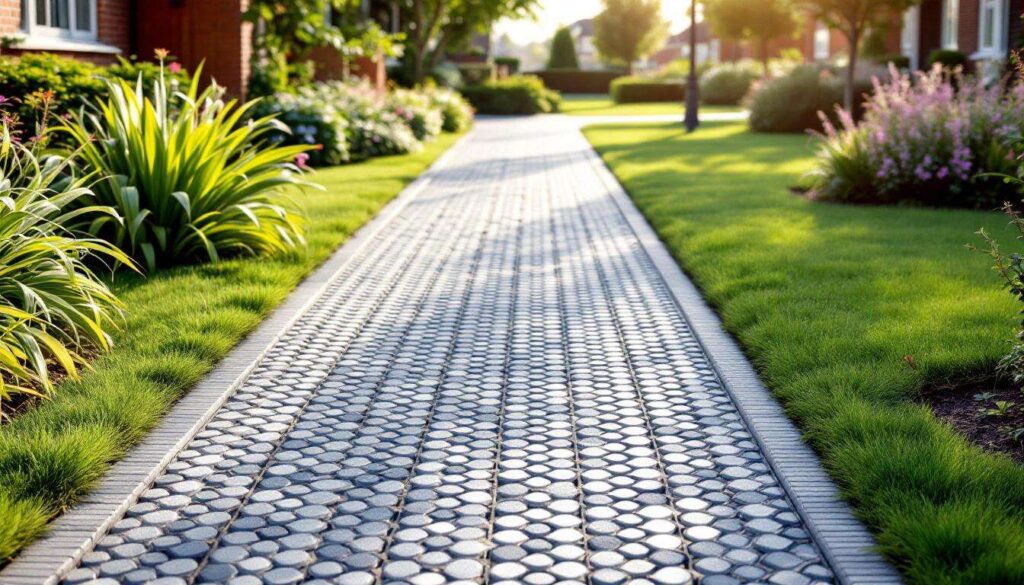
Interlocking permeable pavers represent a versatile option that combines structural integrity with effective drainage. These specially designed blocks feature wider joints or built-in spacers that allow water to percolate between units into an underlying stone reservoir. Available in numerous shapes, sizes, and colours, permeable pavers enable creative pattern designs whilst providing a robust surface suitable for vehicle traffic.
Many manufacturers now produce pavers from recycled materials, further enhancing their environmental credentials. The modular nature of block paving also facilitates repairs and modifications without disrupting the entire driveway surface.
Gravel and decorative aggregate options
Traditional gravel remains one of the most cost-effective and environmentally sound permeable driveway solutions. Modern applications often incorporate stabilisation grids that prevent displacement whilst maintaining excellent drainage properties. Decorative aggregates in various sizes and colours allow for distinctive appearances ranging from rustic charm to elegant sophistication.
The sustainability of gravel driveways is enhanced by:
- Use of locally sourced materials reducing transportation impacts
- Complete permeability allowing maximum water infiltration
- Natural aesthetic that blends with garden environments
- Easy replenishment and maintenance without specialist equipment
Regardless of material choice, homeowners must ensure their permeable driveway installations comply with relevant regulations and planning requirements.
Legal compliance and urban planning: homeowners’ obligations
Planning permission requirements
Understanding when planning permission is required for driveway installations is essential for UK homeowners. Generally, permeable driveways do not require planning permission as they fall under permitted development rights, provided they allow water to drain naturally to a permeable area. However, solid impermeable surfaces exceeding five square metres do require permission unless adequate drainage provisions direct water away from the highway.
These regulations reflect governmental recognition of the environmental importance of permeable surfaces in managing urban drainage. Homeowners should verify specific requirements with their local planning authority, particularly for properties in conservation areas or listed buildings where additional restrictions may apply.
Building regulations and drainage standards
Beyond planning permission, driveway installations must comply with Building Regulations, particularly regarding surface water drainage. Permeable driveways typically satisfy these requirements more easily than impermeable alternatives, as they incorporate sustainable drainage systems by design. Key compliance considerations include:
- Ensuring adequate sub-base depth and composition
- Preventing water discharge onto public highways
- Maintaining appropriate gradients for effective drainage
- Verifying soil percolation rates support infiltration
Professional installers familiar with local regulations can ensure installations meet all necessary standards whilst achieving desired aesthetic outcomes.
Responsibilities regarding highway drainage
Homeowners bear legal responsibility for preventing their driveways from contributing to highway flooding or drainage problems. This obligation has become increasingly significant as climate change brings more intense rainfall events. Permeable driveways inherently address this requirement by managing water on-site rather than directing it toward already burdened municipal systems.
Local authorities may enforce compliance through various mechanisms, and non-compliant installations can result in enforcement action requiring costly remediation. The regulatory framework thus provides additional incentive for choosing permeable solutions that naturally satisfy drainage obligations.
Real-world examples demonstrate how these principles translate into successful installations that delight homeowners whilst benefiting communities.
Testimonials and examples of successful developments in the UK
Residential transformations
Across the United Kingdom, homeowners report high satisfaction with their permeable driveway installations. In Surrey, the Henderson family replaced their cracked concrete driveway with resin-bound surfacing in warm amber tones, transforming their property’s frontage whilst eliminating the pooling water that previously plagued their entrance. Mrs Henderson notes that visitors consistently compliment the driveway’s appearance, often expressing surprise upon learning of its environmental benefits.
Similarly, a Victorian terrace renovation in Edinburgh incorporated reclaimed granite setts in a permeable configuration, creating a historically appropriate yet functionally modern driveway. The homeowner reports that the installation has increased property value whilst contributing to neighbourhood efforts to reduce surface water runoff.
Community-scale implementations
Several UK developments have adopted permeable driveways as standard features, demonstrating their viability at scale. A housing development in Cambridgeshire specified permeable block paving throughout, resulting in measurably reduced strain on local drainage infrastructure. Residents appreciate both the aesthetic consistency and the absence of standing water that affects neighbouring developments with traditional concrete driveways.
Local authorities in flood-prone areas have begun encouraging permeable driveway adoption through:
- Informational campaigns highlighting benefits and installation options
- Streamlined approval processes for compliant permeable installations
- Grant programmes supporting sustainable drainage improvements
- Demonstration projects showcasing aesthetic possibilities
Long-term performance observations
Homeowners with established permeable driveways consistently report sustained performance and maintained appearance over extended periods. A cottage owner in the Cotswolds notes that her gravel driveway, installed over a decade ago, continues to function effectively whilst developing an attractive weathered character that enhances the property’s traditional aesthetic. Maintenance has required only occasional topping with fresh gravel, a task she completes herself at minimal cost.
These testimonials underscore the practical viability of permeable driveways as long-term investments that deliver both immediate aesthetic improvements and enduring functional benefits.
The transition from solid concrete to permeable driveways represents more than a passing trend; it reflects fundamental changes in how homeowners approach property improvement decisions. By prioritising solutions that balance environmental responsibility with aesthetic sophistication, UK residents are creating driveways that enhance both individual properties and broader community resilience. The combination of regulatory support, material innovation, and growing awareness ensures that permeable driveways will continue replacing concrete across the country, offering homeowners elegant surfaces that perform as beautifully as they appear whilst contributing to sustainable water management for future generations.