
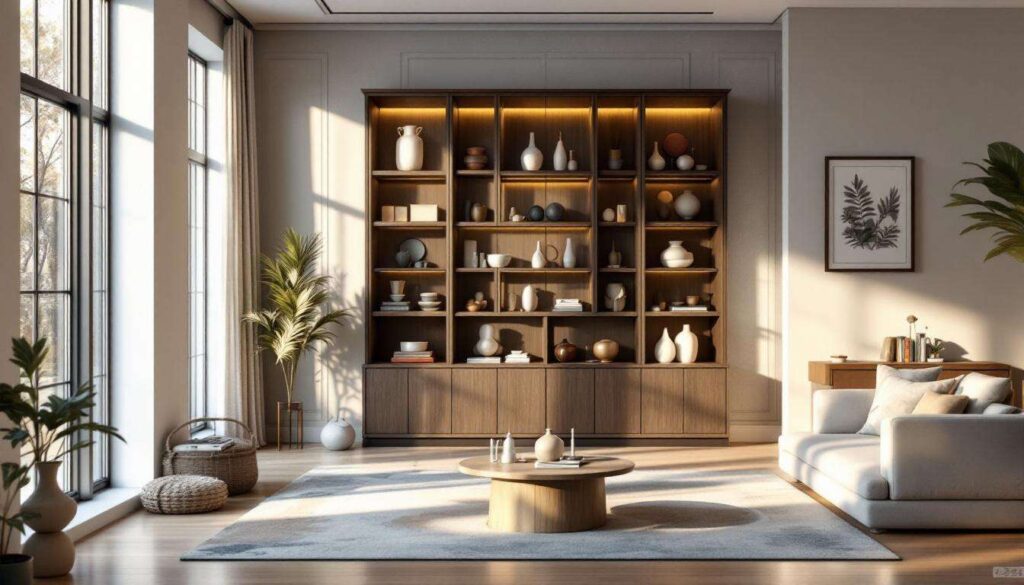
The contemporary home is witnessing a significant shift in how we display our prized possessions and cherished objects. Gone are the days when rows of uniform books dominated our living spaces. Today’s interiors are embracing a more eclectic approach, where carefully curated collections of travel souvenirs, vintage finds, botanical specimens, and artisanal pieces take centre stage. This movement towards curiosity cabinets represents more than just a decorative trend; it reflects our desire to surround ourselves with objects that tell stories and reveal our individual passions. These thoughtfully arranged displays transform functional storage into conversation-starting focal points that breathe personality into every room.
Curiosity cabinets: an essential trend
The renaissance of a historical concept
Curiosity cabinets, originally known as Wunderkammer in Renaissance Europe, served as private collections where wealthy scholars and aristocrats displayed natural wonders, scientific instruments, and exotic artefacts. This historical practice is experiencing a remarkable revival in contemporary interior design, adapted for modern sensibilities. Today’s interpretations blend vintage aesthetics with contemporary functionality, creating spaces that honour the past whilst embracing present-day living requirements.
Why designers are championing this movement
Leading interior designers are advocating for curiosity cabinets because they address several key aspects of modern living:
- They provide visual interest in minimalist spaces that might otherwise feel sterile
- They encourage homeowners to display meaningful objects rather than mass-produced decorations
- They offer flexible styling opportunities that evolve with personal taste
- They create depth and texture through layered arrangements of diverse materials
The versatility of these display systems makes them particularly appealing to those seeking to express their individuality through their living environments. Understanding how storage furniture has evolved helps explain why this trend has gained such momentum.
The evolution of storage furniture in 2026
From functional to decorative priorities
Storage furniture has undergone a dramatic transformation over recent decades. Where once practicality reigned supreme, today’s pieces must satisfy both functional and aesthetic demands. The table below illustrates this shift in priorities:
| Era | Primary Function | Design Focus |
|---|---|---|
| 1990s-2000s | Maximum storage capacity | Uniformity and concealment |
| 2010s | Organisation systems | Clean lines and simplicity |
| 2020s-2026 | Display and curation | Personality and storytelling |
Material innovation and craftsmanship
Contemporary curiosity cabinets showcase remarkable diversity in materials and construction techniques. Manufacturers are combining traditional woodworking skills with modern materials such as brass frameworks, glass panels, and marble shelving. This fusion creates pieces that feel both timeless and thoroughly contemporary. Artisanal makers are particularly thriving in this market, offering bespoke solutions that mass-produced furniture cannot replicate.
These developments in furniture design reflect broader changes in how we perceive the role of books and traditional storage in our homes.
Why traditional bookshelves are losing their appeal
The digital revolution’s impact on physical books
The widespread adoption of digital reading platforms has fundamentally altered our relationship with physical books. Whilst bibliophiles still cherish printed volumes, many households now maintain smaller book collections than previous generations. This shift has freed up valuable display space previously dedicated to floor-to-ceiling bookshelves. Rather than viewing this change negatively, design-conscious individuals are embracing the opportunity to showcase more varied collections.
The monotony of uniform spines
Traditional bookshelves, whilst intellectually impressive, often create visually repetitive patterns that lack the textural variety contemporary interiors demand. Rows of book spines, regardless of their literary merit, can appear monotonous compared to the dynamic arrangements possible with curiosity cabinets. The limitations of conventional bookshelves include:
- Limited opportunities for incorporating three-dimensional objects
- Difficulty in creating visual rhythm through varied heights and depths
- Lack of flexibility in adjusting displays seasonally or thematically
- Minimal scope for integrating lighting to highlight special pieces
This recognition of traditional storage limitations has driven homeowners to seek more expressive alternatives that better represent their multifaceted interests.
Curiosity and personalisation: a winning duo
Telling your story through objects
Curiosity cabinets excel at narrative creation, allowing residents to craft visual stories about their travels, hobbies, and heritage. Each shelf becomes a chapter, with carefully selected objects serving as tangible memories. A seashell collection from Mediterranean holidays might sit alongside vintage cameras, botanical prints, and handcrafted ceramics, creating a rich tapestry of personal history that guests can explore and discuss.
The psychology of curated spaces
Research in environmental psychology suggests that personalised surroundings significantly impact wellbeing and satisfaction with one’s home. Curiosity cabinets satisfy our innate desire to collect, organise, and display meaningful objects. They transform passive storage into active engagement, encouraging us to regularly interact with our possessions and reassess what truly deserves prominent placement. This ongoing curation process keeps interiors feeling fresh and intentional.
Successfully implementing this approach requires understanding specific techniques for creating compelling displays.
The secrets to a successful display
Balancing abundance with restraint
The most effective curiosity cabinets strike a delicate balance between visual richness and breathing space. Overcrowding diminishes individual objects’ impact, whilst sparse arrangements can appear unfinished. Professional stylists recommend the “rule of thirds,” leaving approximately one-third of shelf space empty to allow the eye to rest and appreciate each piece fully.
Practical arrangement principles
Creating museum-quality displays at home involves several key techniques:
- Vary heights by using risers, small boxes, or stacked books beneath objects
- Group items in odd numbers (three, five, seven) for more natural compositions
- Mix textures by combining smooth glass with rough natural materials
- Incorporate lighting through LED strips or small spotlights to highlight treasures
- Rotate displays seasonally to maintain visual interest and prevent staleness
- Use colour theory to create cohesive schemes or deliberate contrasts
Maintaining coherence across diverse objects
Whilst curiosity cabinets celebrate eclecticism, successful arrangements maintain underlying coherence through colour palettes, material families, or thematic connections. A cabinet might focus exclusively on natural specimens, or it might unite disparate objects through a consistent colour story of blues and whites. This subtle organisation prevents displays from appearing chaotic.
These principles can be adapted to complement various interior design approaches and architectural styles.
Incorporating curiosity cabinets into different interior styles
Modern minimalist spaces
In minimalist interiors, curiosity cabinets serve as controlled focal points that add warmth without compromising clean aesthetics. Glass-fronted cabinets with slim metal frames work particularly well, containing collections within defined boundaries. The key is selecting fewer, more impactful pieces rather than numerous small items, maintaining the minimalist principle of “less is more” whilst introducing personality.
Traditional and period homes
Period properties naturally accommodate curiosity cabinets, which can enhance architectural character rather than compete with it. Antique wooden cabinets with glass doors complement Victorian and Edwardian features, whilst Georgian homes benefit from elegant display cases with classical proportions. These spaces allow for more elaborate arrangements that honour historical collecting traditions.
Contemporary eclectic environments
Eclectic interiors offer the greatest freedom for curiosity cabinet styling. Here, mismatched shelving units, vintage laboratory cabinets, and repurposed industrial storage can coexist harmoniously. The emphasis shifts to creating unexpected juxtapositions that surprise and delight, mixing high and low, old and new, precious and everyday objects in thought-provoking combinations.
The curiosity cabinet movement represents a fundamental shift in how we approach interior decoration, prioritising personal narrative over prescribed design rules. These carefully curated displays transform homes into reflections of individual journeys, interests, and values. By replacing uniform bookshelves with diverse collections of meaningful objects, we create spaces that genuinely feel like our own. The trend’s enduring appeal lies in its adaptability: whether your style leans towards minimalism, maximalism, or something in between, curiosity cabinets offer opportunities to showcase what makes your story unique. As we continue seeking authenticity in our living spaces, these thoughtfully arranged displays will remain essential elements of distinctive, personality-rich interiors.