


Bathroom mirrors have evolved from simple reflective surfaces into sophisticated fixtures that combine functionality with cutting-edge technology. The integration of LED lighting and defogging systems represents a significant leap forward in bathroom design, transforming daily routines whilst addressing one of the most persistent annoyances: steam-covered mirrors after a hot shower. These innovative mirrors are no longer exclusive luxuries reserved for high-end hotels or premium developments. The technology has become increasingly accessible, offering homeowners an opportunity to enhance their bathrooms with features that deliver both practical benefits and aesthetic appeal. As manufacturing processes improve and competition increases, what was once considered a premium upgrade has entered the mainstream market, making it a viable option for a wide range of budgets and bathroom styles.
LED bathroom mirrors: modern and functional lighting
The advantages of integrated LED systems
LED bathroom mirrors provide superior illumination compared to traditional overhead lighting, eliminating harsh shadows and creating an even distribution of light across the face. This proves particularly valuable for tasks requiring precision, such as applying makeup, shaving, or skincare routines. The technology offers several distinct benefits:
- Energy efficiency: LED systems consume significantly less electricity than conventional bulbs, reducing running costs
- Longevity: LEDs typically last between 30,000 and 50,000 hours, eliminating frequent bulb replacements
- Colour temperature options: many models offer adjustable warmth settings to suit different times of day or preferences
- Consistent brightness: LEDs maintain stable light output without flickering or dimming over time
Placement and lighting configurations
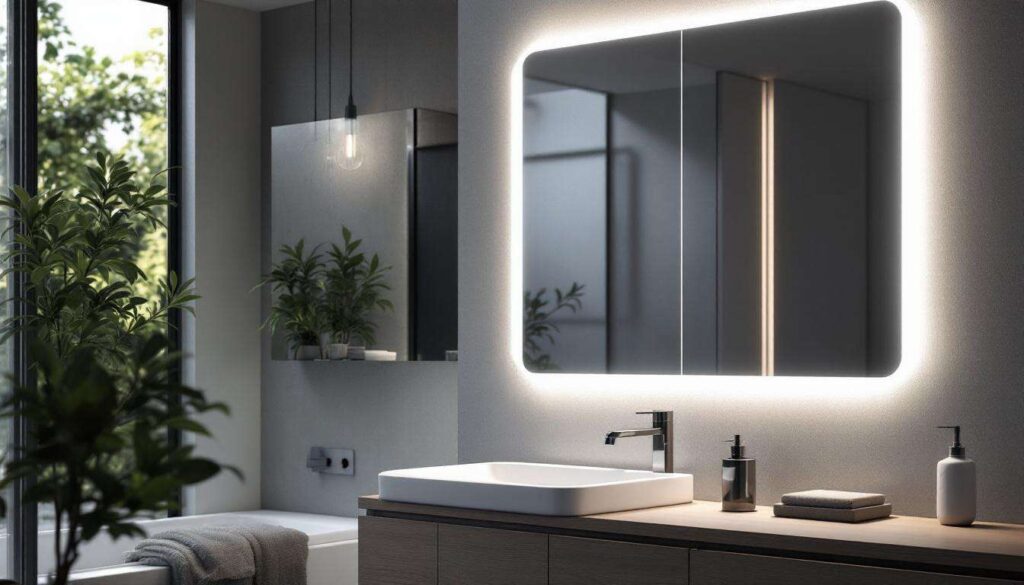
Modern LED mirrors feature various lighting arrangements to suit different needs and aesthetic preferences. Backlit designs create an ambient glow around the mirror’s perimeter, producing a floating effect whilst providing soft, indirect illumination. Front-lit configurations position LEDs along the mirror’s face, delivering direct light ideal for detailed tasks. Some premium models combine both approaches, allowing users to switch between modes depending on requirements. The strategic placement of these lights ensures that the reflection remains clear and accurately represents colours, which proves essential for grooming and cosmetic applications.
These lighting innovations naturally complement another technological advancement that addresses a common bathroom frustration.
Defogging technology: how does it work ?
The science behind heated mirror pads
Defogging systems utilise thin heating elements positioned behind the mirror surface, typically consisting of conductive materials that generate gentle warmth when electricity passes through them. These heating pads maintain the mirror surface at a temperature slightly above the dew point, preventing condensation from forming. The technology operates on a simple principle: warm surfaces cannot support water vapour condensation, ensuring the mirror remains clear even in steamy bathroom conditions. The heating elements are designed to distribute warmth evenly across the entire surface, avoiding hot spots or inconsistent performance.
Power consumption and activation methods
Modern defogging systems are engineered for minimal energy consumption, typically drawing between 20 and 50 watts depending on mirror size. This modest power requirement translates to negligible running costs, particularly given that the system only operates during bathroom use. Activation methods vary across models:
| Activation Type | Description | Best For |
|---|---|---|
| Manual switch | User activates system via button or touch sensor | Conscious energy management |
| Automatic with light | Heating engages when mirror lights are switched on | Convenience and simplicity |
| Motion sensor | Detects presence and activates automatically | Hands-free operation |
| Timer function | Runs for predetermined duration then switches off | Preventing unnecessary operation |
Understanding the mechanics reveals why these systems deliver such practical advantages in daily use.
The practical benefits of heated LED mirrors
Eliminating post-shower frustration
The most immediate benefit of integrated defogging technology is the elimination of waiting time after showers or baths. Traditional approaches to clearing steam, such as wiping with towels or running cold water, prove both ineffective and time-consuming. Towel wiping leaves streaks and lint, whilst cold water creates only temporary clear patches. Heated mirrors maintain perfect clarity throughout bathroom use, allowing immediate access for grooming tasks without interruption. This seemingly simple improvement significantly enhances the morning routine, particularly in households where multiple people share bathroom facilities and time efficiency matters.
Hygiene and maintenance advantages
Beyond convenience, defogging systems contribute to improved bathroom hygiene. Constant moisture on mirror surfaces creates ideal conditions for mould and mildew growth, particularly around edges and seams. By preventing condensation, heated mirrors reduce these risks substantially. The technology also minimises the need for chemical cleaning products, as the absence of water marks and streaks means less frequent cleaning is required. When cleaning does become necessary, the smooth, uninterrupted surface of modern LED mirrors proves easier to maintain than traditional mirrors with separate lighting fixtures that collect dust and grime.
These functional improvements align perfectly with contemporary design philosophies that emphasise both form and practicality.
Design trends: aesthetics and innovation
Minimalist integration and seamless profiles
Current design approaches favour clean lines and unobtrusive integration, with LED mirrors exemplifying this aesthetic. Frameless designs dominate the market, creating sleek profiles that complement modern bathroom schemes. The elimination of visible fixtures, switches, and hardware contributes to a streamlined appearance that enhances perceived space, particularly valuable in smaller bathrooms. Touch-sensitive controls replace traditional switches, maintaining the minimalist aesthetic whilst providing intuitive operation. Some models incorporate controls directly into the mirror surface, invisible until activated, further reducing visual clutter.
Smart features and customisation options
Advanced models now incorporate intelligent features that extend beyond basic illumination and defogging:
- Bluetooth connectivity for audio streaming during bathroom routines
- Integrated digital displays showing time, temperature, and weather information
- Colour-changing LED options for ambient mood lighting
- Magnification zones for detailed grooming tasks
- Voice control compatibility with home automation systems
These innovations reflect broader trends towards connected home technology whilst maintaining focus on practical bathroom applications.
Despite their sophisticated features, these mirrors remain surprisingly straightforward to implement in existing bathrooms.
Installation and maintenance: simplicity and efficiency
Professional installation considerations
Whilst LED mirrors with defogging require electrical connections, installation proves relatively straightforward for qualified electricians. Most models operate on standard household voltage and connect to existing bathroom circuits. The process typically involves securing the mirror to the wall using mounting brackets, connecting the electrical supply, and ensuring proper earthing for safety. Many manufacturers provide detailed installation guides and support, with some offering professional installation services. The key consideration involves ensuring adequate electrical capacity, though the modest power requirements of these systems rarely necessitate circuit upgrades in modern homes.
Long-term maintenance requirements
One of the most appealing aspects of LED mirrors with integrated defogging is their minimal maintenance demands. The sealed LED units require no bulb replacements, and the heating elements have no moving parts to wear out. Routine care involves only occasional cleaning with standard glass cleaner and a soft cloth. The absence of separate light fixtures eliminates dust accumulation points, reducing cleaning frequency. Manufacturers typically provide warranties ranging from two to five years, reflecting confidence in the technology’s reliability. Should issues arise, many systems feature modular components that allow targeted repairs without replacing the entire unit.
This combination of straightforward installation and minimal upkeep contributes significantly to the overall value proposition.
A worthwhile investment: accessibility and energy savings
Price points and market accessibility
The market now offers LED mirrors with defogging across a wide price spectrum, making the technology accessible to various budgets. Basic models start around £150 to £200, providing essential lighting and defogging functions in standard sizes. Mid-range options between £300 and £600 incorporate additional features such as adjustable colour temperature, touch controls, and premium finishes. High-end models exceeding £800 deliver advanced smart features, larger dimensions, and designer aesthetics. This range ensures that most homeowners can find suitable options without compromising essential functionality. The competitive market has driven prices down considerably, with features that commanded premium pricing now available in entry-level models.
Calculating long-term savings
Beyond initial purchase costs, LED mirrors deliver ongoing financial benefits through reduced energy consumption and maintenance expenses. A typical LED mirror consumes approximately 80% less electricity than equivalent traditional lighting, translating to annual savings of £20 to £40 depending on usage patterns. The extended lifespan of LED components eliminates bulb replacement costs, saving an additional £30 to £50 over a decade. When combined with reduced cleaning product requirements and the elimination of separate heating solutions, the cumulative savings often offset the initial investment within five to seven years. These figures become even more favourable when considering the enhanced property value that modern bathroom fixtures provide.
LED bathroom mirrors with integrated defogging represent a convergence of practical innovation and accessible pricing that transforms daily routines. The combination of superior lighting, condensation prevention, and minimal maintenance creates tangible improvements in bathroom functionality. As technology advances and manufacturing scales increase, these features have transitioned from luxury additions to sensible investments that enhance comfort whilst delivering measurable energy savings. The diverse range of available models ensures compatibility with various aesthetic preferences and budgets, making this upgrade achievable for most homeowners seeking to modernise their bathrooms with proven, reliable technology.