



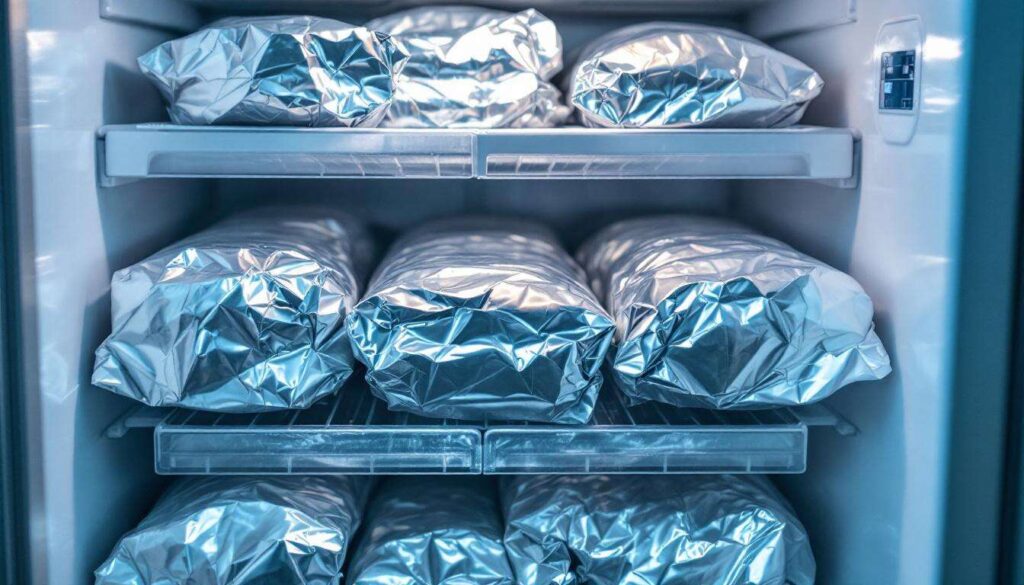
Households across the country are discovering an ingenious solution to improve their freezer storage: aluminium foil. This simple kitchen staple is proving to be far more versatile than many realise, offering practical benefits that extend beyond wrapping sandwiches. From preventing freezer burn to enhancing energy efficiency, this method is rapidly gaining traction among those seeking smarter ways to manage their frozen goods.
Why use aluminium foil in the freezer ?
Protection against freezer burn
Freezer burn remains one of the most common complaints when storing food for extended periods. This phenomenon occurs when air comes into contact with frozen food, causing dehydration and oxidation. The result is discoloured patches, a leathery texture, and compromised flavour. Aluminium foil creates an impermeable barrier that prevents air exposure, maintaining the integrity of meats, vegetables, and prepared meals. Unlike plastic wrap, which can allow moisture to escape, aluminium foil provides superior protection when properly sealed.
Reducing food waste
The financial implications of food waste are considerable for most households. By wrapping individual portions in aluminium foil, families can:
- Store precisely measured quantities for single meals
- Avoid defrosting more than needed
- Extend the usable life of perishable items
- Maintain food quality for longer periods
This approach transforms how people interact with their freezer contents, making it easier to plan meals and reduce unnecessary waste.
Space optimisation
Bulky plastic containers occupy significant freezer space and create organisational challenges. Aluminium foil-wrapped items can be shaped to fit available spaces efficiently, maximising storage capacity. This flexibility proves particularly valuable in smaller freezers where every centimetre counts.
Understanding these practical benefits naturally leads to questions about the science behind aluminium foil’s effectiveness.
The power of aluminium foil: how it works
Thermal conductivity properties
Aluminium possesses exceptional thermal conductivity, meaning it rapidly adjusts to surrounding temperatures. When food wrapped in aluminium foil enters the freezer, the foil quickly reaches freezing temperature, helping to lock in freshness immediately. This rapid cooling minimises ice crystal formation within food cells, preserving texture and nutritional value.
Barrier characteristics
The molecular structure of aluminium creates an effective shield against three key enemies of frozen food:
- Moisture migration that causes freezer burn
- Oxygen exposure leading to oxidation
- Odour transfer between different foods
This triple protection ensures that frozen items maintain their original qualities, whether stored for weeks or months.
Reflective properties for energy efficiency
Beyond food protection, aluminium foil’s reflective surface can contribute to improved freezer performance. When used to line freezer walls or shelves, it reflects cold air back into the compartment, potentially reducing the workload on the compressor. This effect, whilst modest, can accumulate into noticeable energy savings over time.
With these scientific principles established, implementing the method correctly becomes the next consideration.
The foolproof method of aluminium foil
Proper wrapping technique
Achieving optimal results requires attention to wrapping methodology. The process involves several critical steps:
- Place food in the centre of a sufficiently large foil sheet
- Fold the foil over the food, bringing edges together
- Create a tight seal by folding edges multiple times
- Ensure no gaps or openings remain
- Press foil firmly against the food surface to eliminate air pockets
The key lies in creating an airtight seal that prevents any air circulation around the food. Loose wrapping defeats the purpose and allows freezer burn to develop.
Double wrapping for extended storage
For items intended for long-term freezing, a double-layer approach provides enhanced protection. After completing the initial wrap, add a second layer of aluminium foil, ensuring the seams of the outer layer do not align with those of the inner layer. This overlapping technique creates redundancy that guards against accidental tears or punctures.
Labelling considerations
Aluminium foil’s opaque nature presents identification challenges. Using permanent markers to note contents and freezing dates directly on the foil surface proves essential for effective freezer management. Alternatively, adhesive labels designed for freezer use can be attached before wrapping.
Once the wrapping technique is mastered, broader freezer optimisation strategies become relevant.
Optimising your freezer with aluminium foil
Strategic placement of wrapped items
The arrangement of foil-wrapped foods influences both accessibility and energy efficiency. Flat, uniform packages stack more efficiently than irregular shapes, creating organised layers that facilitate air circulation. Proper circulation ensures consistent temperature distribution throughout the freezer compartment.
Creating a frost-prevention system
Lining freezer shelves with aluminium foil can help combat frost accumulation. The foil’s smooth surface makes ice removal simpler during defrosting sessions, whilst its reflective properties may contribute to more stable temperature maintenance. This application works best on wire shelving where foil can be secured without impeding airflow.
Batch preparation benefits
Combining aluminium foil wrapping with batch cooking creates a highly efficient meal management system. Preparing multiple portions simultaneously and wrapping each individually transforms the freezer into a personal convenience food repository. This approach offers:
| Benefit | Impact |
|---|---|
| Time savings | Reduced daily cooking requirements |
| Cost efficiency | Bulk ingredient purchasing at lower prices |
| Portion control | Predetermined serving sizes prevent overeating |
| Variety | Multiple meal options available simultaneously |
Selecting appropriate materials ensures these optimisation strategies deliver maximum effectiveness.
Which type of aluminium foil should be preferred ?
Standard versus heavy-duty options
Aluminium foil comes in various thicknesses, each suited to different applications. Heavy-duty foil offers superior puncture resistance and durability, making it ideal for wrapping items with sharp edges or bones. Standard foil suffices for softer foods and shorter storage periods, whilst being more economical for everyday use.
Width considerations
Wider rolls reduce waste when wrapping larger items, eliminating the need to overlap multiple narrower sheets. A 30-centimetre width accommodates most household freezing needs, whilst 45-centimetre options suit those frequently storing larger cuts of meat or batch-cooked meals.
Recycled content options
Environmentally conscious consumers may prefer recycled aluminium foil, which requires significantly less energy to produce than virgin aluminium. These products perform identically to conventional foil whilst reducing environmental impact. Many manufacturers now offer recycled options without premium pricing.
Food-grade certification
Ensuring foil carries appropriate food-grade certification guarantees it meets safety standards for direct food contact. Reputable brands display relevant certifications on packaging, providing assurance that no harmful substances will migrate into stored food.
These material choices directly influence the practical and financial benefits users experience.
Savings and simplicity: the double benefit of aluminium foil
Financial advantages
The economic case for aluminium foil in freezer management proves compelling. Initial investment remains minimal, with a single roll lasting months for typical household use. Reduced food waste generates the most significant savings, as properly stored items remain edible far longer than inadequately protected alternatives. Additionally, potential energy efficiency improvements, though modest, contribute to lower electricity bills over time.
Convenience factors
Beyond financial considerations, aluminium foil offers practical advantages that simplify daily life:
- No washing required unlike reusable containers
- Flexible shaping accommodates irregular food items
- Quick wrapping process saves preparation time
- Direct oven transfer possible for many foods
- Lightweight material adds negligible weight to shopping
Environmental perspective
Whilst disposable materials raise sustainability questions, aluminium foil presents a relatively favourable environmental profile. Aluminium is infinitely recyclable without quality degradation, and many local authorities accept foil in recycling programmes. When cleaned and recycled properly, foil represents a more sustainable choice than single-use plastic alternatives that cannot be effectively recycled.
This combination of cost-effectiveness, practicality, and reasonable environmental credentials explains the growing adoption of aluminium foil for freezer storage. Households seeking straightforward solutions to common food preservation challenges find this method delivers tangible results without requiring specialist equipment or complex procedures. The technique’s accessibility ensures that anyone can implement it immediately, transforming their freezer from a source of wasted food into an efficient resource for meal planning and household economy.